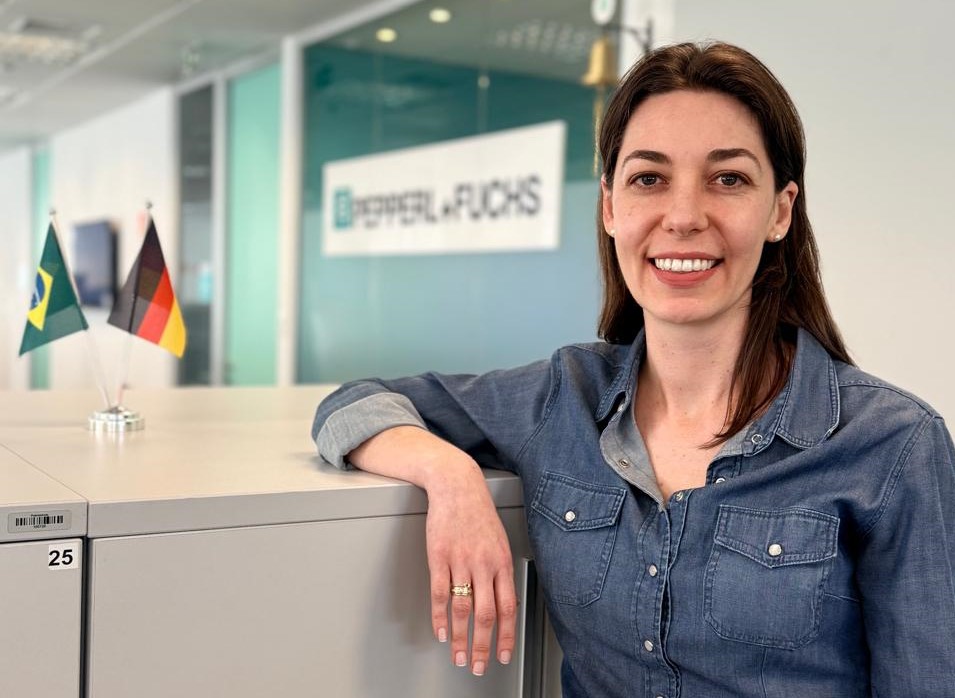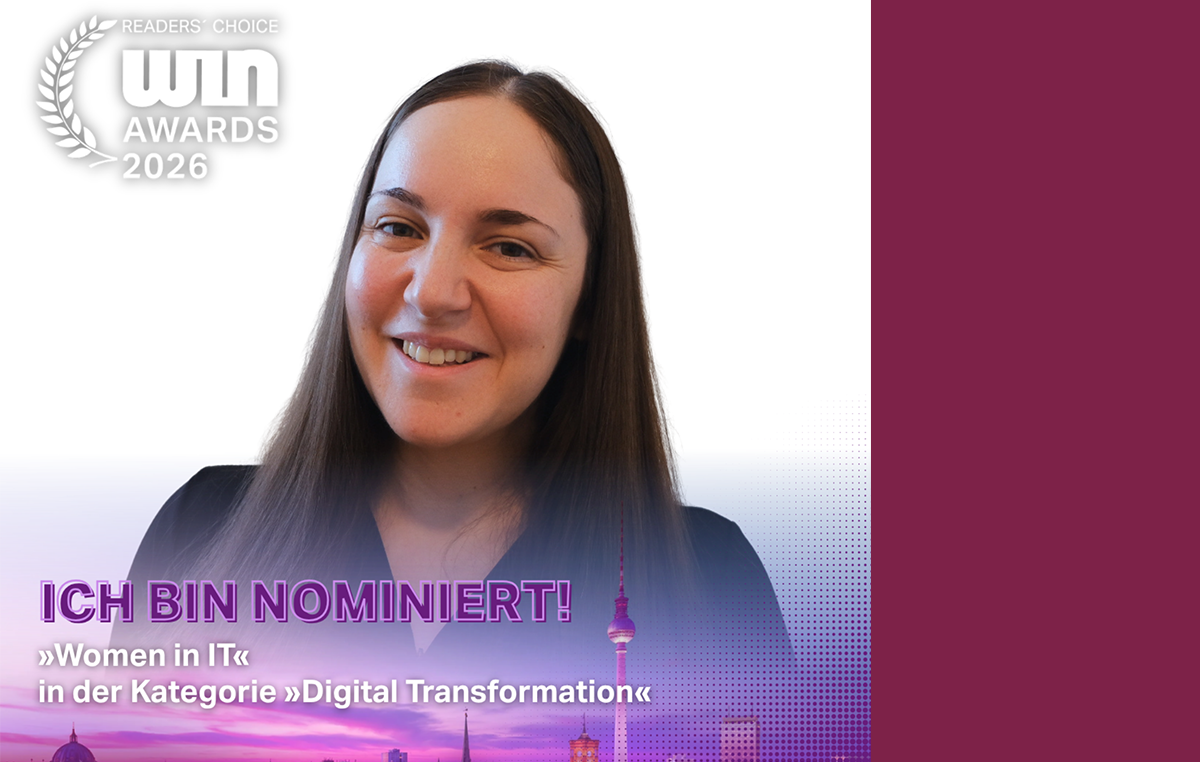
With a passion for electrical engineering, Elena came to Germany many years ago with the goal of studying the subject. Today, she holds a leadership position at Pepperl+Fuchs and has been nominated for the “Female in IT”-Award (FIT Award) – an award that recognizes women who are shaping the digital future. In the interview, Elena talks about her career journey, her passion for IT and technology, women in the IT sector, and what this nomination means to her.
Hello, Elena. What exactly do you do at Pepperl+Fuchs?
I am the Head of Project Management Office (PMO) for Mobile Communication & HMI. In my role I lead an international team of project managers, providing the framework, methods, and support they need to execute the projects successfully, including their continued professional development. In my day-to-day work I am also in constant communication with various departments. Projects often reveal issues and opportunities for improvement because they connect different functions and processes. So, I focus on understanding what is important to each department, their priorities and pain points, and where we can create value. This helps us not only solve issues within individual projects, but also improve our processes and ways of working across the organization in the long term.
In parallel, I lead strategic initiatives, like post-merger integration projects following the acquisition of companies.
Passion for technology
What excites you about your job?
The diversity of tasks, challenges, projects, and people I get to work with. There is always something new to learn or a new perspective to discover. Looking back at my career at Pepperl+Fuchs, I find it incredible to see how many opportunities I have been given to grow. I started in engineering and moved into management through a global talent program. I’m still very grateful for the trust and support I received. I moved from engineering to project management, then to post-merger integration management, and eventually to my current role as Head of PMO. Just as important is the collaboration I experience every day. Again and again, I meet colleagues from different departments who want to improve things, help each other, and move things forward together.
How did you come into your current area of responsibility?
The path into my current area of responsibility started with a decision I made quite early in my life: I came to Germany to study electrical engineering. I’ve been fascinated by technology, science, and robotics since I was young. I always imagined myself developing things and understanding how technology works, and that naturally led me toward engineering. During my studies, I received a scholarship from Pepperl+Fuchs and did an internship, through which I got to know the company from the inside. I felt very comfortable here and there were many opportunities to learn and grow.
As I developed professionally, my interests also started to evolve. I still had a strong passion for technology, but I became increasingly curious about what happens beyond the technical implementation. I wanted to understand how decisions are made, how different parts of a business come together, and how I could contribute to shaping those decisions. That curiosity gradually led me toward broader responsibilities. I realized that I wanted not only to develop technology, but also to influence decisions, contribute to strategy, lead people, and have a broader impact. That evolution ultimately brought me to where I am today.
FIT Award: Recognizing women who are shaping the digital future
Let’s talk about a current topic. What exactly is the FIT Award?
The FIT Congress stands for Females in IT – Future of IT and has been bringing women in IT together since 2017. As part of the congress, the Women’s IT Network and Vogel IT-Akademie present the WIN Awards, recognizing women who are shaping the digital future. They cover areas including E-Health, E-Government, and Business IT, with categories such as Digital Transformation, Start-Up, and Leadership. What I particularly like is how they highlight women who are already working in IT and achieving a lot, sometimes quietly and without much visibility. They put a spotlight on these achievements and show the diversity and impact of women who are already playing significant role in the IT sector.
How did you come to be nominated for the FIT Awards in your category?
I was nominated by a friend, which made it particularly meaningful. She saw my work and contribution in IT and decided to put my name forward. I was incredibly happy and thankful. It showed me that she believes in me and supports what I do. I was also very honored to be among around 20 other women nominated in the same category, whom I believe are achieving a lot in their respective fields. Being part of this group and having my work recognized in this way is something I truly appreciate.
Women in IT
Why are women so important in IT, in your opinion?
I believe women are important in IT because they bring different perspectives and ways of approaching problems. Different perspectives can lead to better solutions, especially when dealing with complex challenges. I also believe female and male characteristics complement and strengthen each other. I don’t believe in a strict division of what women or men can or should be. But I do think qualities often associated with women, such as empathy, active listening, finding balance, and sharing a vision, can be valuable alongside qualities often associated with men, such as assertiveness, decisiveness, directness, and a strong drive to achieve. For me, the strength is in bringing these different characteristics together. They can complement and strengthen each other, creating a more balanced approach to leadership and collaboration.
What distinguishes you?
My curiosity, willingness to keep learning, and technical background, which motivates me to understand how things work and how the different parts connect. That systems thinking helps me see the bigger picture across people, processes, technology, and business. I’m also very persistent, and I bring passion into everything I do. Every new role is a chance to challenge myself, broaden my perspective, and keep learning.
But there’s another thing that’s important to me. I don’t just want to take knowledge from one role and move on. I want to leave something behind. So I see my role as building on what others have created, adding my own contribution, and leaving something meaningful behind. It’s about being part of something bigger, not the center of it. I want to help teams grow stronger, so that what remains after I’m gone is more than what was there before.